Events and more...


See Coming Up tab at the top of the page for updates


Monday, 3 August 2015

Rorscharch interview in translation...

I promised I'd post this at some point, so here it is:

Read the interview in Spanish here at Revista Bardo, super Argentinian poetry magazine, focussing specifically on spoken word culture.

1)      At what age did you start writing poetry?
I wrote a ‘get well’ poem for my aunt when I was 7. Does that count?
As a kid, I read and listened to a lot of rhyming stories and funny poems. At some point – I can’t be sure exactly when – I started making my own

2)      At what age did you start reciting it?
I wasn’t aware of “oral poetry” as a genre before. I remember reading out John Agard’s “I din’ do nuttin’” as a kid at home, out loud. But that’s the kind of thing I did at home with my siblings; we always recited things and sang. Later, as a teenager, I got into hip-hop and I would create and perform raps with friends. It wasn’t until I discovered the spoken word scene in London when I was about twenty-one that I started performing poetry in public.

3)      Why do you keep doing it?
I ask myself the same question a lot!
Short answer: it’s addictive.
Medium answer: A lot of people I really like keep inviting me to perform and I don’t want to say no; a lot of my social life revolves around the spoken word scene. I often get free drinks tickets at these things.
Longer answer: It’s a bit like asking why I write. I write because it’s an innate part of my self-expression; it’s how I make sense of the world. Performing poetry is the counterpoint to all of that: when I speak my words, I let go. When I speak, I connect directly with other people. When I speak, all of my inward energy and all of the considered thought that goes into a poem goes back out into the room.

4)      How was the first time that you recite in public?
Hehe. For me, it was gradual. I’d acted in a play before. I’d tried to start a rap group before, when I was at school. So going to a small open mic night in London wasn’t a massive step away from what I’d already done. For me, the biggest step was moving from there to my first ever slam. That was exciting and strange and new. The energy at a poetry slam can be immense, a far cry from some of the quieter poetry nights around the city. 

5)      What does poetry win (gain?) when recited?
Some of the same things that a script gains when it’s made into a movie. Spoken word is a 3D version of a poem; it has rhythm, dialect, pace, volume and, of course, the physical presence of the author… all these things transform it into a moment.

6)      What does it lose?
Some words might get lost. The audience has less control over the poem. They cannot contemplate the line breaks, or the visual aesthetic of the words. They cannot pause and allow the words to sink in. The author/performer has a lot more responsibility in delivering meaning.

7)      What does poetry serve for?
Big question! I’ll have to answer it in three smaller ways, in order to chisel away at it a little.
1 – On a personal level, it gives me a lot of pleasure playing with words. I sit on a bus and mishear a line of conversation and it replays in my head until I write it down. Or I toy with an idea, or a sound, and try to alter the meaning by making small changes. Words are important in how we communicate and poetry is a way of creating new meaning. 
2 – On a physical level, poetry has literally taken me to places I would most likely never have been: several secondary schools and universities in London, the Channel Islands, Warsaw, Washington D.C., FLUPP festival in Rio de Janeiro, etc… And in all those places, I have encountered open, warm people with a passion for truth and knowledge-sharing.   
3 – On that level of truth-sharing, I remember running a writing workshop at a centre for people living with HIV, a couple of years ago. Few of the attendees had done any creative writing before; all of them had signed up because they were interested in exploring new ways to express themselves. One of the attendees told me she disliked and had little confidence in her ability to write poetry. Yet, when she gave herself over to the exercises, she wrote the most amazing poem, in the form of a love letter to HIV. She had found a metaphor that best described her daily relationship with her medical condition. When she read it out, you should have felt the atmosphere in the room. She had just found a way of putting into words how she felt that everyone could relate to. Poetry is basically about metaphor and story-telling, in order to get to a higher truth, in order to transfer a feeling or a moment in time.      

8)      Do you find poetry in everyday situations, nature or anywhere else?
Yes.
When I’m in the mood, I can find poetry anywhere. When I’m not, I find it very difficult to write but I still try.

9)      It´s the existence of men necessary for poetry to exist?
Men – or humans in general?
There would continue to be poetry without men, no doubt.
Humans, on the other hand… well, that’s more of an existential question. The conditions that poetry describes – some of those will still exist without humanity. 

10)   What feelings does reciting in public arise you? Does it frighten you?
Yes. It frightens me. And it’s also exhilarating.

11)   Which was the best experience that you lived with oral poetry?
I’ve had a lot of great experiences, so can’t really pin one down and say that was the best. I’ve just come back from Rio de Janeiro… that was one hell of an amazing experience. I got to perform at a slam as part of a favela literary festival, FLUPP, with loads of people from other countries, having no idea if the surtitles behind me were going ok or not! Or performing with a samba band during that same festival. Or, last year, watching a pupil I taught at a school performing a poem… and understanding all of the circumstances in her life that had led her to that point where she was confident enough to read out her poem, and have everyone applaud… that’s also incredible. Or maybe even the gig a few weeks ago where a couple of my relatives turned up unexpectedly. Or one where I gave the most honest, raw poem about my parents, which I may never repeat again… I could go on!

12)   Which was the most incredible place where you recited?
See above…. FLUPP.

13)   Can oral poetry change the world?
Probably.

14)   Why is it important to write poetry?
In my answer to question 7, I think I started to touch on it. Again, it’s a big question…
Poetry is about partially about finding metaphors. If I say: “this question is a donkey and I need to pull its reins”, I’ve started to use metaphorical language that then leads to interrogation of the question. How can the question be a donkey? What commonality do these two things have? I start to make connections between two unrelated concepts and I start to use my imagination to pull the strands together. When we start to use our imaginations, it takes us from the present reality into other possibilities…. There goes the theory, right?
Going back to question 7, when the woman from the workshop described her medical condition as her lover, I began to see it – and her – in a different way. The poem was a little dark, actually. It wasn’t the conventional lover you can just split up with! But the poem was short, and powerful, and I gained a new understanding of the woman in front of me – and other people in the room were moved to tears – just because of the way in which she used a few words.   

15)   Do you believe in poetry as an educational tool?
Yes -  but I would say that; I’ve used it in schools and I’ve used it as a form of emotional literacy, as well as a tool for encouraging literacy in general.

16)   Is oral poetry a new genre, opposed to written poetry?
No.
Have new spoken word movements arisen over time? Yes.
But poetry has always had a wide history of being spoken as well as written.

17)   Is humor a valid resource in oral poetry or does it turn it into standup comedy?
Yes, humour is valid and sometimes necessary. But I come from a country with a huge tradition of satire, so I would say that. You can be funny and make a point; in fact, when you’re funny, it can make a serious point have an even bigger impact. Stand-up comedy and oral poetry have a lot in common.

18)   Does the oral poet have to write for the public or for himself?
It depends on the editing process. I always write for myself first. I make sense of the world by writing. I make sense of myself by writing. I write a lot of stuff that no one else will ever see.
Then… and this is the important bit, I think… I reread what I’ve written and think, which parts of this will only make sense to me? Which parts could be different? Which parts do I have a personal attachment to, but aren’t going to connect with other readers/listeners?  For me, that’s one of the hardest bits.

19)   How important is the body when reciting?
Very. My body is part of the poem.
That doesn’t mean I’m acting when I’m on stage, or that I’m going to be making loads of theatrical movements. But, at the very basic level, it means I’m going to pay attention to my posture, my breathing, my use of space and movement, my facial expressions, etc.

20)   Can performance on stage turn good a poem that isn´t?
Sometimes, if you have the right combination of an extraordinarily compelling performer who can deliver words in a convincing way, what they’re actually saying becomes less of a focus.

21)   In that sense, is the "how" more important that the "what"?
No. They’re two sides of the same poetry coin.

22)   Can anyone be an oral poet?
Yes. Absolutely anyone. Just like anyone can be a footballer, musician, serial killer… If you have the passion for it and put in the time, why not?

23)   Do competitions such a Slams contribute to oral poetry or do they turn it into something frivolous?
Slam culture has had a huge and overwhelmingly positive impact on oral poetry; there’s no denying it. By the same token, I disagree that you can really judge a poem’s merit on a scale of 1-10, against other poets, on any given evening, based sometimes purely on applause. If that was the real point of slam poetry, then I would refuse to take part; the competitive element has the function of attracting new audiences, making poetry nights more atmospheric, making it a democratic space, and allowing different voices to be heard.


MORE UPDATES COMING SOON!

Friday, 24 July 2015

Countdown to pamphlet launch...


I Speak Home now feels realer than ever.

Over a year ago, I started collecting poems for this '20/20 series' collection, after winning Eyewear's pamphlet competition. The brief: I had to write twenty poems, and they had to be suitable for a 'pamphlet', i.e. not rambling epic poems that took the word count up; it needed to be a slim-spined teaser of a book, but substantial enough to showcase my work.

A year on and I'm proud of what's come out of it. Although much of the poems were written 1-2 years ago, in the run up to me submitting for the competition, many drafts later - and with the addition of more recent work - I've got something I'm fairly proud of (I don't say this easily).

As for the title, I wanted something to signpost that the concept of 'home' turns up in nearly all of the poems. The book starts off with the bold anthem 'This is a poem', which I took from a sign on a wall in Camden (my home turf), before drifting off to poems about places I've called home and places I've belonged/longed for, and ending with the poem 'E17' and the words: 'I miss my old home* like an empty fridge'. I didn't want to call it 'I Write Home' because I wanted speech in the title somehow. It's as much about saying and not saying as it is about writing... I just hope that all comes across, and I'm looking forward to feedback from readers.

Next Wednesday (29th July) is the launch party for I Speak Home and, I believe, three other books on Eyewear's Pamphlet list. I'll give fuller details after the weekend, so stay posted!

 *Actually, I've lost track of drafts but I think I've now changed 'home' to 'community' in this poem.  

Tuesday, 14 July 2015

July things

I'm back from the Lambda Writers' Retreat and all of the intense experiences there. In just a week of the residency, I wrote a chapter, a first draft ending of my novel, a poem, a small scene (which I read at a public event in Downtown L.A.) and went to talks, workshopped fellow writers' work, exchanged ideas, stayed up all night with some fantastic people. I averaged about three or four hours sleep a night (which is kind of comparable with a week at the Edinburgh Fringe).


Afterwards, I spent my birthday in the city, walking along Santa Monica beach (with nothing between me and Japan but miles and miles of Pacific Ocean) and driving up to Hollywood to do all the tourist crap. I have so many unforgettable experiences of my trip that, any time I've been asked, 'How was it?', I've mumbled and stuttered and barely been able to answer. I mean... I mean... I mean... Yeah, it was great! (We'll do this conversation another day).

Not even four hours after landing in London, I went to a book launch (check this review here - I've just started reading it today and I'm already gripped). Then I caught up with family the next day, approved the final proof of my poetry pamphlet on Monday (it's out in just a couple of weeks!!) and started plugging three gigs that I had last week. All of them were wildly different (Bar Wotever @ Royal Vauxhall Tavern, Incite @ Phoenix Artists' Club and Jazz Verse Jukebox @ Ronnie Scott's... all worth checking out!) and rewarding in themselves. I'm especially looking forward to seeing footage from Jazz Verse Jukebox!

That all said, it's no surprise that finally, finally, on a day that doesn't demand so much of me (I'm not working today) that I feel exhausted and more than a little flat. I'm not sure how much is left inside of me. I feel dehydrated and lethargic and I only managed to get out of bed at 1pm. I'm almost ready to go back already, but I do actually have things to do later, so I'll have to wait a few hours.

Looking back over a couple years' worth of posts, I can see that I usually post stuff here when I have exciting news coming up, or when I've been putting a lot of energy into thinking about one thing, but I often disappear when there's nothing.

cheesy feet

Image result for determination quotes background
cheesier image

---Do you remember that Footprints poem? (It must have been in the late 90s that pretty much any relatives' house I went to had it hanging on the wall with one of those bland sandscapes behind it... And/or a poster of an abstract word with a cheesy quote and image. I'm sure I'm not the only one) The months you only see one post, it's then I'm carrying myself along. If I'm too preoccupied to blog - for reasons good or bad - my webprints disappear.---

Anyway - weird aside over - after this weekend is through, I'm actually looking forward to locking myself away for a bit and not doing so much/ not seeing people for a couple of weeks. I won't be under the kind of pressurised conditions that helped me write a chapter (and subsequently lose the USB stick I saved it on to... don't ask... I'm still panicking about that) but I'll keep chipping away.

Lambda Fiction Fellows 2015

Probably the biggest thing I'll take away from the Lambda retreat was the confidence boost. I can't speak for the other genres, but the fiction cohort was pretty solid. Every day at 9am, I was anxious to return to our too-hot seminar room at the University of Southern California where we went over our manuscripts and exercises. It was a room of thirteen very talented writers and I was delighted to be included as one of them (incidentally, I was the only non US-citizen who made it into the fiction workshop this year - but I'm sure there'll be more again in the future). I initially felt overwhelmed, but as the week went on and I settled in, that feeling changed to a feeling of pride and bravery. If I put the work in, I'll end up with a novel I'm immensely proud of - and others agree.

*
Creative Guilt?

About four years ago, I had this conversation with a guy, who happened to be a doctor. I remember downplaying pretty much everything I did, possibly in a bid to impress him or deflect attention from me. I remarked that, of course, my Spanish degree wasn't as difficult as a degree in Medicine. I'd had so many unstructured hours as an undergraduate and, compounded with fewer responsibilities as a languages student, and the fact that I spent a year abroad -  there was no way you could compare the two. Not that Spanish had less worth... just that it was easier. He wasn't impressed by my argument and, in fact, seemed pretty insulted. I found myself backtracking... "It's just easier for me. You know... I couldn't turn up to 8am lectures every day and remember all of those Greek words and learn precise procedures like you guys did. But yeah, I guess some medics would have felt the same way doing what I did."

What I remember of my undergraduate degree was fun, for the most part. I had to watch films (and analyse them, which meant I watched them more than once). I had to read novelists and poets, lots of them. Garcia Marquez. Lorca. Vallejo. Cortazar. Cernuda (Not enough women though). I had to travel. I had to prepare presentations and spend time just in conversation. In conversation! Ok, it was all in Spanish but it was something that interested me. Years later, and I look at people who did supposedly "hard" subjects and, yes, it does sometimes seem like I had an easy ride.

I feel the same about writing sometimes... until I think about all the hard work I actually do that doesn't feel like work, until I consider all the time off the clock that I don't count. Just as I used to spend a lot of my free time watching films and reading books, which then went into my essays about other books/films, I now spend a lot of my time watching poets on YouTube and reading books at home and while commuting. I never count that as work. There's such a blur between work and play to me, even when the work is hard. Writing the chapter two weeks ago - complete with several edits, before and after feedback - wasn't particularly easy but, interspersed with late-night socialising antics and sitting around in thirty degree L.A. heat and getting to know new friends on the other side of the world, I struggle to call it work, even though, clearly, it is.
      
*
5 more things

Once again, plenty of updates are on the way. But here's 5 things for now!

1) I Speak Home, my new poetry pamphlet, is out on the 29th!!! There's a launch party that evening, with readings from fellow poets who also have pamphlets out. (Check them out here)


2) The Midnight Run London epic summer special is on Saturday night. I believe it's sold out already! There are now a couple of spaces for "runs" from the Almeida and Roundhouse. I'll post more on this Thursday.

3) Walthamstow Garden Party is on Sunday. I'm looking forward to taking a group of young people I've been working with to perform there.

4) Edinburgh countdown begins soon... In just over a month, I'll be up again, in a couple of shows (check out "Upcoming" section) and taking part in the BBC Slam.

5) I can't remember the fifth thing. Ask me another time.  


Friday, 12 June 2015

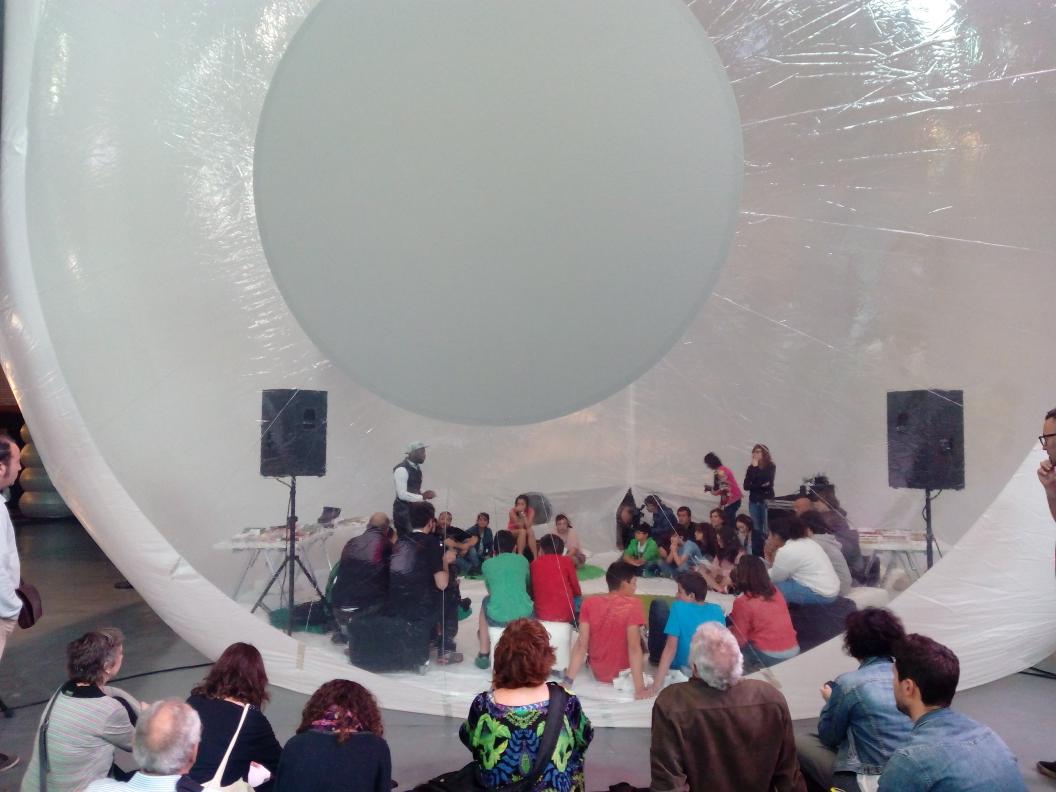
Two weeks ago, I was performing inside a giant eyeball and it wasn't a dream...


...and it wasn't the kind of thing I had on a list of 101 things to do before I die, either. It wasn't even something I knew I was going to do before I arrived in Bilbao, to take part in the 3, 2, 1, International Festival.

You can hear my nerves two days before the show, in this video:


I was pretty overwhelmed, after a morning teaching poetry workshops at a local secondary school... in Spanish. What they always tell you about language is if you don't use it you lose it. I hadn't been in a teaching situation with Spanish-speaking pupils for at least 8 years... and even then, that wasn't in Spain.

There are different ways of addressing groups of people (vosotros/ustedes/vos...), depending on which country you're in and your relationship to the listener; there are also different words for certain objects, according to which country you're in, sometimes mutually intelligible, and often not; add to the mix me, a non-native speaker who has picked up elements of different Spanishes and hasn't had to talk formally in any of those for a long time. Despite listening to Spanish radio every morning for a few weeks beforehand and meticulously looking up certain phrases I might use in the classroom (hoarding = síndrome de diógenes), I was nervous that I'd lost it somewhat. What was I doing there?!

Multidisciplinawary

When I'm in a multilingual situation, my tongue trips over words a bit more than normal, until I start to settle. When I'm surrounded by people from different fields, that much more so. The world and language of performance poetry can be pretty specific - or, dare I say, limited.

I'd stepped off the plane, was picked up from the airport, put my bags down, and was immediately met by hosts and taken to the Alhóndiga/Azkuna centre, where the festival opening was taking place, down at the gallery level. With my scruffy t-shirt and jeans, and even scruffier half-beard, I enjoyed the contrast of smartly-dressed, smiling faces, holding beers, and pondering the walls of photographs, one of the festival's centrepieces. I didn't feel out of place, exactly; I felt rock star, making my grand entrance, scoping out the venue, grabbing my own quota of free beer, until... until...

It was at this wall of photographs, standing next to the festival's director and the programmer, with little to say in any language other than "qué interesante" and "me gusta", that a friend's words came back to me. I'm appalled at how little British poets spend time getting to know art from other disciplines. I felt illiterate, a feeling not uncommon for everyday people who end up at a gallery. But this wasn't an everyday situation, given who I was standing next to!

In my weak defence, since last year, I make a point of going to see some art exhibition or another every month, and I get friends to recommend me new music every now and again, but I very rarely connect it with my own writing. The spoken word scene is so accessible and informal that it doesn't seem compatible to me. As for the more "formal" structures of writing, I spend so much time criticising the stuffiness/incestuousness of the established poetry world (and there is a lot to laugh at, including the storm surrounding the poem the LRB published recently) that I don't really engage with anything else aside from my own politics and personal life when it comes to poetry; when it comes to my fiction, I'm still finding my way, but I've been so set on completing the novel - a very established, semi-stagnant form - that I have little room to see how changes in art/photography/music/dance/sculpture might impact it.* And so I'm not used to being anything more than a passive observer.      

I hadn't heard of Ray Lee before, a British artist whose Sirens project was beyond the wall of photographs, featured as a two-month installation at the centre. Nor had I seen John Berkavitch, a poet who I knew of, as our paths have crossed before a few times (and he arrived at the festival just as I left!). Until I had received an invite to the festival, I hadn't been aware of the Basque tradition of Bertsolaris, either, poetry/song improvisers who take part in competitions that attracts thousands (see link for a video about this). The problem is I can't have heard or seen everything, but the more I do find out about, the more I realise there is to investigate.

Found in translation 

I'd been asked to put on a "poetry slam"** show, which was later clarified by the organisers: I wouldn't be putting on an actual slam or an auto-slam - battling against myself - but they wanted the energy of a spoken word show in a multi-disciplinary environment. I'd be performing in English - with brief Spanish asides as I segued between poems - and my poems would be translated into Castillian Spanish for the audience and printed, so they could refer to the translations at any point.


I can only begin to describe the emotional impact of sitting in a hotel room on a Wednesday night, swigging from a bottle of shop-bought gazpacho and reading through thirty-odd pages of my poems that had been translated as faithfully as possible by a professional; the feeling that someone meticulously combed through the words, a stranger who mostly understood my propensity to play around with double meanings and very specific cultural reference points. It felt like a warm hug that lingers too long, squeezes a little too tightly, finding the knots on your back you didn't know were there.

It was incredible reading my own work through another lens, and it was pretty much spot on. But there's no such thing as a perfect translation. A very basic example: "the" has no direct equivalent in Spanish... when it becomes "él" or "la", it takes on a gendered quality that doesn't really exist in English; by the same token, something written in English sheds some of its meaning when the wordplay and slang has to be made slightly more neutral***, but the extra nuances it gains as the sounds of words make different patterns is spectacular. I can't wait to start memorising some of my poems in Spanish; I will feel like I've gained a new set entirely, without having written anything.... Props to the translator, whose name I still don't know!

In short...

By the third day of school workshops, I felt as if I'd been there for ages. My language came back. The kids were great. I spent ten minutes high-fiving everyone before saying goodbye (in the Basque language: "Agur"). That emotional connection you get from teaching, when a previously lost-looking pupil just gets it, when you come to the end and have to repeatedly tell them to put down their pens, that it's time to finish up, that feeling when you can tell that it's not the end for them, that they'll write more again, share more... that you haven't put them off writing for ever, after all... that feeling is priceless. 

I did my thing later that evening, coming face to face with the eyeball, giving it all I had with my poetry set and frequent riffs in Spanish. Some of the pupils came to see the show, and I was again very nervous.

They'd had time to flick through their translations and I'd noticed giggles and whispers before the show as a few of them discovered the point where I break between two poems and deliver a haiku:


Given this, and the fact I was mostly going to be speaking in English for 45 minutes, I expected a negative reaction from one or two pupils during the performance. Contrary to expectations, they were attentive and engaged throughout the whole performance. There was a very mixed audience sat inside, or stood/knelt/sat outside and it was crazy! I liked being inside my bubble, moving around the space, tapping at the transparent section and waving at passing spectators.

Halfway through, I took a deep breath and muttered to myself: "You better remember this moment". I'm sure I'll continue to do exciting, unusual and challenging things as time goes on. I just hope to always retain that feeling of wonder whenever I step into a new situation.
   
_____

*The insularity of spoken word poetry goes both ways, of course. The spoken word scene is undergoing many subtle changes across the country and worldwide, yet the language used to describe it by outsiders isn't changing. It's still seen as an "underground" or "emerging" movement, hip-hop's milder, beat-less cousin... and those who run spoken word workshops with young people aren't shown to be the literary pioneers they are; instead they are speakey-spokey social workers (please check that link to see the extent to which words can be twisted. It's actually quite disturbing... and reminds me of a similar angle I ended up allowing an interview to go ten years ago!)

**Still don't know what a slam is? Try reading this page or watching this brief video explanation. Or, just Google it.

***In one of my pieces - yes, I said pieces -, I use the unfortunate word "sket", a word which even people in some London audiences won't get. Whenever I take that poem out of London, I use "hoe". (I really hate both words, but I have to use them to chart my journey out of self-defensive teenage misogyny). If I'd kept "sket", the translator would have had to find the equivalent of a word that has been shortened from another dialect (search for the origins of "sketel") and found common usage among a teenage late 1990s population wherever the target audience is. It's an impossible task; so some implications about the subject and the listener of the poem get lost. Also, when I say "there are too many wrongs/ to write" in another piece, the translator, of course, had to make the decision to stay faithful to the words written and not the tension between "write/right". There's no other way of doing it without over-complicating a simple statement.    

Tuesday, 9 June 2015

UPCOMING GIG: TONIGHT!!!! Stand Up & Slam!!


Apologies for the late post but make it if you can!

Once again, we'll be pitting ourselves against the might of the stand-up comedy crew, proving that words and verse are more powerful than jokes alone... with Camden Comedy Club (upstairs at Camden Head). It'll be a compact, Edinburgh-show-style hour, following Mark Watson's work-in-progress show.

Details are to be found here.